The role of RF engineering in quantum computing
Precision at the limits of performance
Quantum computing promises to transform the way some of the world’s most complex computational problems are approached. But behind the quantum processor lies an equally demanding engineering challenge: how to control, manipulate and read quantum states with extraordinary precision.
For several leading quantum computing architectures, RF and microwave engineering forms a critical part of that control environment.
Precisely generated signals must reach quantum devices with the required frequency, amplitude and phase while introducing as little noise, distortion and unwanted interference as possible. As quantum systems increase in scale and complexity, achieving that level of control becomes an increasingly significant engineering challenge.
Why does quantum computing need RF and microwave technology?
In superconducting quantum computers, qubits typically operate at microwave frequencies and are manipulated using carefully controlled microwave pulses. These signals can change the state of a qubit, while microwave techniques also play a critical role in reading its state.
The principle may sound straightforward. The reality is anything but.
Quantum states are extremely sensitive to their environment. Unwanted noise, signal distortion, thermal energy, crosstalk and interference can all degrade system performance.
The RF signal chain therefore has to do far more than simply carry signals to and from the quantum processor. It must generate, condition, deliver and recover them while preserving exceptional levels of signal integrity and precision.
Controlling the qubit
For a quantum operation to be performed successfully, control signals need to arrive at the qubit at precisely the right frequency, power, phase and time.
That places significant demands on the RF architecture.
Signal generation, frequency conversion, amplification, attenuation and filtering can all influence the quality of the signal ultimately presented to the quantum device.
Even small imperfections matter.
Phase noise, amplitude variation, frequency instability or unwanted signals can reduce the accuracy with which quantum states are controlled. As systems become more sophisticated, RF performance therefore becomes part of the wider challenge of achieving reliable, repeatable quantum operations.
Reading extraordinarily small signals
Controlling a quantum state is only half of the challenge. The system must also determine what state the qubit is in.
In superconducting architectures, this commonly involves microwave resonators coupled to the qubits. A microwave readout signal interacts with the resonator, and changes in that signal can be measured to infer the state of the qubit.
These measurement signals can be extremely weak.
Low-noise amplification, filtering, frequency conversion and careful management of the receive signal chain are therefore important to extracting useful information while introducing as little additional noise as possible.In this environment, signal integrity is not simply about communications performance. It is an important contributor to readout fidelity and the ability of the system to make reliable, repeatable measurements.The challenge of operating at extreme temperatures
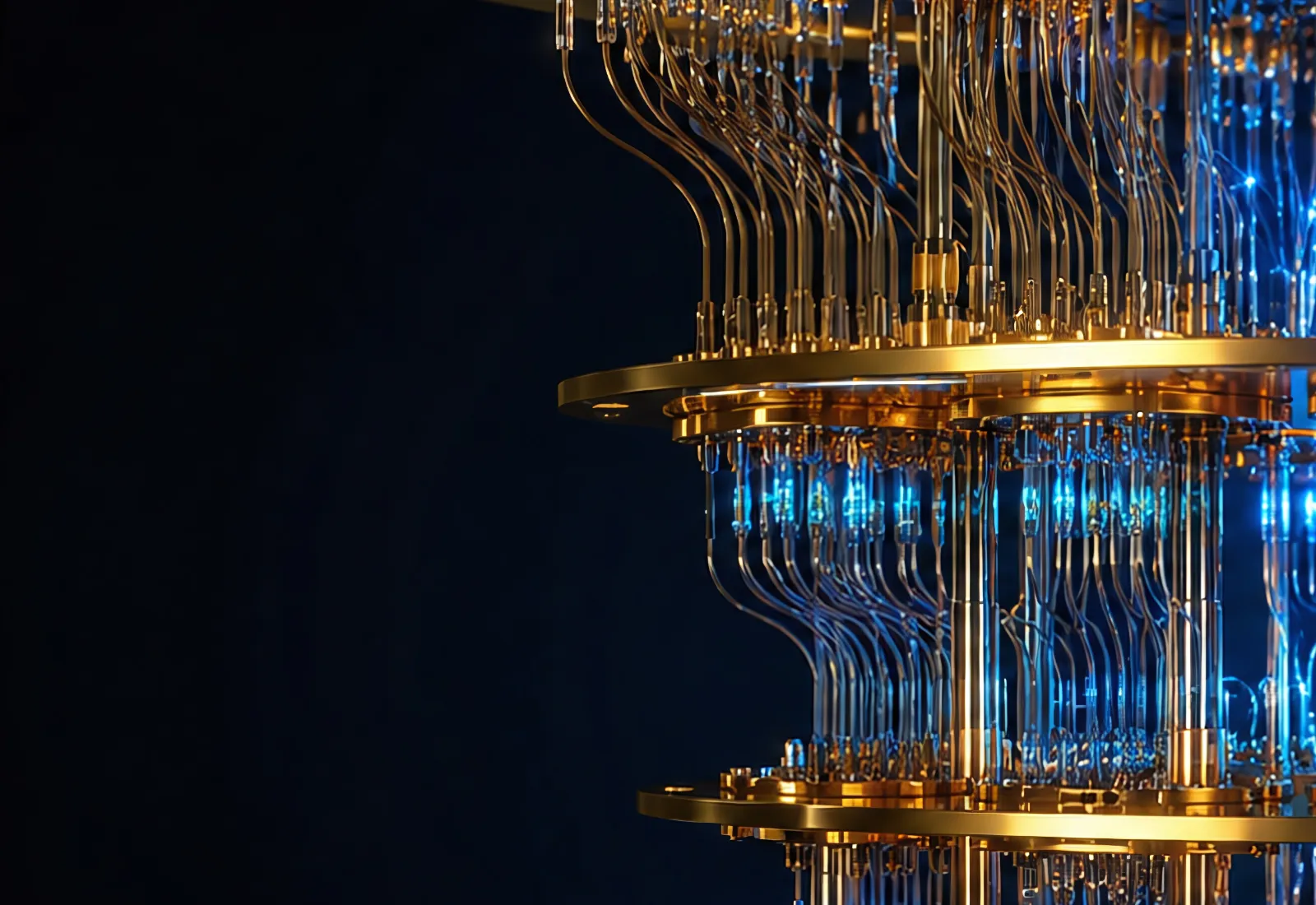
Many quantum processors operate at cryogenic temperatures, with superconducting qubits typically requiring environments measured in millikelvin.
That creates an unusual RF engineering problem.
Control and readout signals may need to travel between conventional electronics operating at room temperature and quantum devices deep within a cryogenic system.
Every cable, connection and electronic device has consequences. Heat transfer must be controlled. Noise must be suppressed. Signals must be attenuated and filtered appropriately while maintaining the characteristics required for accurate control and measurement.
As a result, the RF architecture cannot be considered independently of the thermal and physical architecture of the quantum system.
Scaling changes the RF challenge
Some of today’s most important quantum engineering challenges arise not from controlling an individual qubit, but from controlling many of them.
As quantum processors scale, so does the number of signals that need to be generated, routed, filtered, controlled and measured.
Simply multiplying individual RF control chains creates practical challenges around cabling, physical space, power consumption, thermal load and system complexity.
This is driving research into technologies including cryogenic control electronics, signal multiplexing and more highly integrated microwave architectures.
The direction of travel is clear: scalable quantum computing will require increasingly sophisticated integration between quantum devices and the classical electronic systems that control them.
Why filtering and signal integrity matter
Quantum systems operate in an environment where unwanted energy can have disproportionate consequences.
Filtering helps prevent out-of-band signals and electromagnetic interference from reaching sensitive parts of the system, while careful RF design helps manage reflections, losses, impedance discontinuities and other effects that can degrade signal quality.
This makes precision filtering and signal-chain optimisation important considerations across both control and readout architectures.
The objective is not simply to create a clean RF signal. It is to create an electromagnetic environment in which quantum devices can operate predictably.
From individual devices to complete architectures
This is where the role of RF engineering in quantum computing is evolving.
As quantum technology moves from experimental systems towards larger and potentially commercially viable platforms, attention increasingly turns to the architecture surrounding the quantum processor.
- How efficiently can signals be generated and distributed?
- How can noise and interference be controlled?
- How can hundreds or potentially thousands of control and readout channels be accommodated?
- How can the RF architecture be integrated without creating unacceptable thermal load?
- And how can performance be manufactured and reproduced consistently as systems scale?
These are fundamentally systems-level engineering questions.
Applying high-frequency expertise to a new frontier
Filtronic has spent decades solving demanding RF, microwave and mmWave challenges where signal integrity, precision, reliability and repeatable performance are fundamental.
Quantum computing presents a very different application, but many of the underlying engineering disciplines are familiar: high-frequency design, low-noise performance, precision filtering, frequency conversion, signal integrity, advanced packaging, manufacturing and test.
As quantum architectures evolve, bringing these disciplines together will become increasingly important in developing the control and readout infrastructure required to move quantum computing from individual breakthroughs towards scalable systems.
Engineering the environment quantum systems depend on
The potential of quantum computing ultimately lies with the qubit. But unlocking that potential depends on much more than the quantum device itself.
It depends on the complex infrastructure that surrounds it — generating, conditioning, transporting and measuring signals with exceptional control.
RF engineering is an important part of that infrastructure.
And as quantum systems scale, achieving greater precision, lower noise and tighter integration across the complete signal chain will become increasingly critical to turning quantum potential into practical capability.