How is high-frequency RF changing satellite communications?
More spectrum. More capacity. A new generation of Satcom architecture.
The demand placed on satellite communications is changing rapidly.
Global broadband, high-capacity data services, increasingly connected infrastructure and expanding satellite constellations are driving the need to move more information between space and Earth -faster, more efficiently and across increasingly sophisticated networks.
One of the technologies enabling that change is high-frequency RF.
Moving communications into higher microwave and millimetre-wave frequency bands gives satellite operators access to significantly greater bandwidth. That creates the potential for higher-capacity links, greater data throughput and new approaches to the way satellite networks are designed.
But moving higher in frequency also changes the engineering challenge.
Greater capacity must be balanced against atmospheric attenuation, signal loss, power efficiency, thermal performance and the increasingly demanding precision required across the RF signal chain. The result is a new generation of satellite communications in which high-frequency RF performance is becoming fundamental to overall network capability.
Why are satellite communications moving to higher frequencies?
Spectrum is a finite resource.
As demand for satellite connectivity grows, established frequency bands have become increasingly congested. At the same time, modern satellite networks are expected to transport vastly greater volumes of data.
Moving higher in the frequency spectrum provides access to wider bandwidths.
Ka-band has already become an important foundation for high-throughput satellite communications. Beyond Ka, Q/V-band offers additional spectrum for very high-capacity feeder links, while E-band and emerging W-band applications open further possibilities for advanced communications architectures. This progression is not simply about operating at a higher number of gigahertz. It is about creating more space in which information can move.
What does higher frequency mean for network capacity?
In simple terms, greater available bandwidth creates the potential to transmit more data.
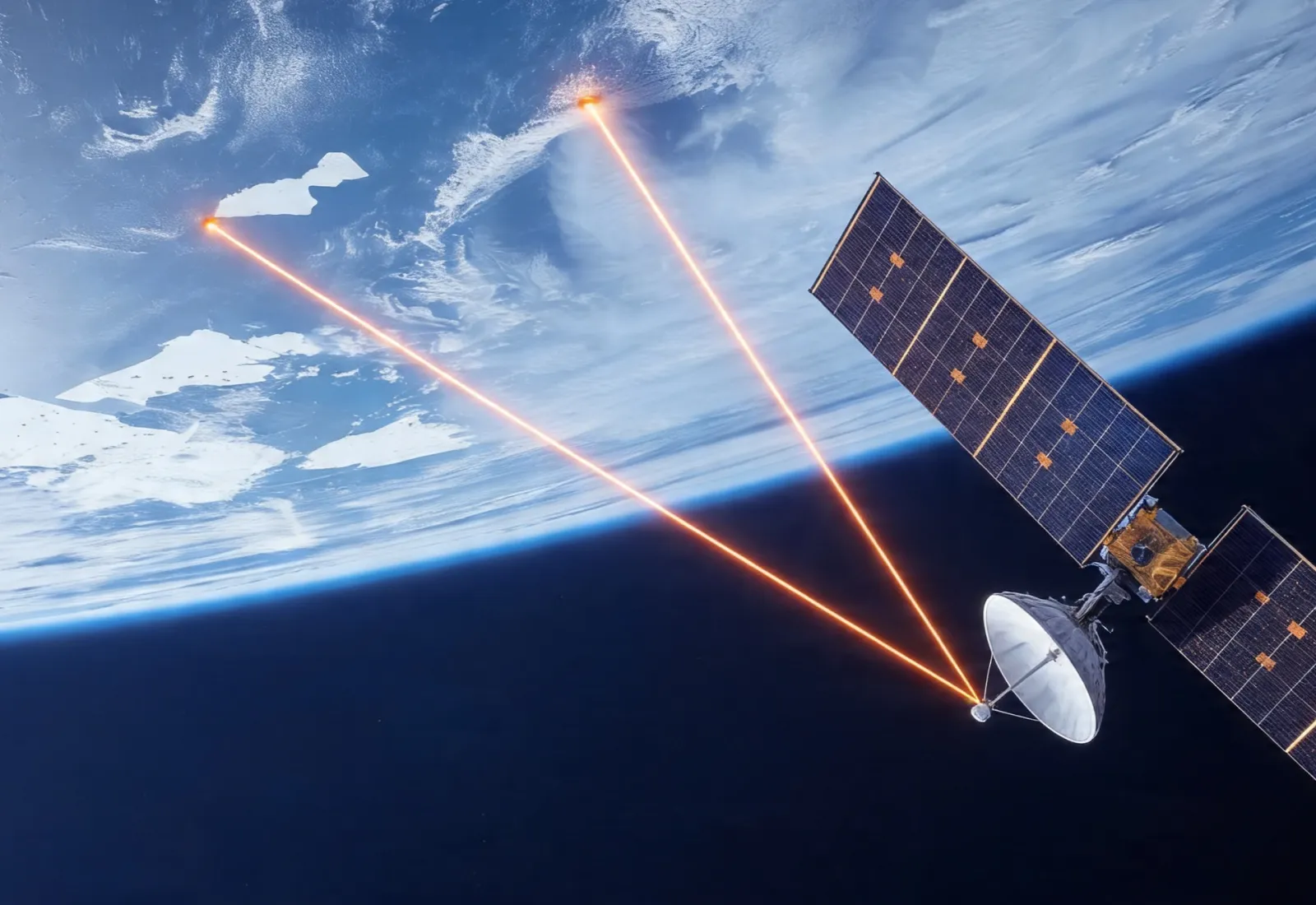
This is particularly important for High Throughput Satellite (HTS) and Very High Throughput Satellite (VHTS) architectures, where enormous amounts of information need to move between satellites, gateways and users. The feeder link, the high-capacity connection between the satellite network and its ground infrastructure, can become a significant constraint as user capacity increases.
Moving feeder links into higher frequency bands can provide additional spectrum and help release capacity in other bands for user connectivity. The result is a more efficient use of the available spectrum across the complete satellite network.
From Ka-band to Q/V-band
Ka-band has played a major role in increasing the capacity of modern satellite systems, supporting broadband connectivity and high-throughput architectures. But increasing demand is driving interest further up the spectrum. Q- and V-band frequencies offer substantially greater available bandwidth and are increasingly being considered for next-generation feeder links. One potential architecture uses Ka-band for connections between satellites and users while moving the high-capacity gateway or feeder link into Q/V-band. This allows operators to use valuable spectrum more efficiently while creating the capacity required to move increasing volumes of data between the satellite network and the ground. For RF engineers, however, the move introduces new challenges around power generation, amplification, filtering, frequency conversion, antenna design and atmospheric propagation.
E-band: bringing terrestrial mmWave experience into space
Higher-frequency Satcom is not developing in isolation. E-band has already been established in terrestrial communications, where its wide available bandwidth has enabled extremely high-capacity point-to-point wireless links and network backhaul.
Those characteristics make E-band increasingly relevant to satellite communications.
Operating around 71–76 GHz and 81–86 GHz, E-band provides significantly wider channel bandwidths than lower-frequency alternatives, creating opportunities for high-capacity feeder links, ground infrastructure and other advanced communications applications. The engineering challenge is to translate the performance achieved in terrestrial E-band systems into technologies capable of meeting the different requirements of space and ground-segment architectures. This requires high output power, efficiency, signal integrity and precise control at frequencies where losses and manufacturing tolerances become increasingly significant.
And beyond E-band?
W-band pushes high-frequency capability further still.
Operating between 92–114 GHz, W-band remains considerably more exploratory for communications than established Satcom bands. Its potential extends across advanced sensing, Earth observation, synthetic aperture radar, scientific instrumentation and future high-capacity communications. At these frequencies, wavelength becomes extremely small and the engineering tolerances correspondingly demanding. The progression towards W-band therefore represents more than an extension of existing RF technology. It requires advances in semiconductor performance, packaging, waveguide technology, manufacturing and test.
The opportunity is significant – but so is the engineering challenge.
Why do feeder links matter so much?
A satellite network can only move as much data as its infrastructure can support. As user-link capacity increases, feeder links connecting satellites to gateway infrastructure can become a bottleneck.
High-frequency feeder links provide one route to increasing that capacity. By moving gateway traffic into frequency bands with greater available spectrum, operators can transport larger volumes of information between terrestrial networks and space-based infrastructure.
This also has implications for the ground segment. Gateways need high-performance amplification, frequency conversion, filtering and receive capability capable of maintaining reliable links at frequencies where atmospheric conditions can have a much greater impact on signal propagation.
High-frequency Satcom is therefore not simply a space-segment development. It is driving innovation across the complete network.
The atmospheric challenge
Moving higher in frequency brings an important trade-off.
Higher-frequency signals are generally more susceptible to atmospheric attenuation, particularly from rain and other weather conditions. This means the additional bandwidth available at frequencies such as Ka and Q/V cannot simply be treated as free capacity. Networks must be engineered around the propagation environment.
Link budgets, gateway location, power levels, antenna performance, adaptive techniques and network architecture all become part of maintaining service availability.
Future high-capacity networks may consequently rely not just on higher-frequency technology, but on increasingly intelligent architectures capable of responding dynamically to changing link conditions.
Power becomes increasingly important
Higher frequencies also place greater demands on RF power generation.
Satellite links need sufficient transmitted power to overcome propagation losses and maintain the required signal quality at the receiver. Generating that power efficiently becomes more challenging as frequencies increase. Advances in semiconductor technologies such as gallium nitride (GaN), combined with innovative amplifier architectures and power-combining techniques, are helping engineers deliver greater RF power at increasingly high frequencies.
Efficiency matters too.
Whether equipment is located on a satellite or within a ground station, power consumption and the heat generated by RF amplification influence the size, weight, cooling requirements and overall economics of the system. High-frequency power amplification is therefore becoming an important enabling technology for next-generation Satcom.
Every part of the signal chain matters
Increasing the operating frequency places greater demands across the entire RF architecture. Signals need to be generated, amplified, filtered, converted, transmitted and received while maintaining their integrity.
At mmWave frequencies, relatively small losses or imperfections can have a significant impact on overall system performance.
Filters must provide the required selectivity without introducing excessive loss.
Frequency converters need to move signals between bands while controlling noise and unwanted products.
Transmit and receive systems must preserve signal quality.
Power amplifiers need to deliver increasingly demanding combinations of output power, efficiency and reliability.
The performance of the communications link is therefore determined not by any single RF technology, but by how effectively the complete signal chain works together.
Manufacturing becomes part of RF performance
As wavelengths become shorter, physical dimensions and manufacturing tolerances become increasingly important.
Features that might have relatively little effect at lower frequencies can become significant at mmWave frequencies. Surface finish, material properties, assembly accuracy, packaging, interfaces and repeatability can all influence RF performance. This means advanced manufacturing and process control become part of the high-frequency engineering challenge. A design that performs exceptionally in simulation is only valuable if that performance can be reproduced consistently in manufacture.
For satellite operators and prime contractors looking to deploy technology at scale, repeatability becomes as important as peak performance.
High-frequency RF is changing the architecture, not just the frequency
Perhaps the most important change is architectural.
Moving into higher-frequency bands allows engineers to reconsider how capacity is distributed across the satellite network.
User links, feeder links, gateway infrastructure, payloads and potentially inter-satellite connectivity can use different parts of the spectrum according to their requirements. This creates opportunities for more flexible networks capable of allocating capacity more intelligently and scaling as demand changes.
The RF architecture becomes part of the network architecture. And that means high-frequency performance increasingly needs to be considered at system level rather than as a collection of individual components.
Turning spectrum into capability
Filtronic has spent decades developing high-frequency technologies across RF, microwave and mmWave frequencies, with capability spanning K/Ka, Q/V, E and emerging W-band applications.
That experience brings together many of the disciplines becoming increasingly important to future satellite networks: high-power amplification, low-noise receive capability, frequency conversion, transmit and receive technologies, precision filtering, advanced manufacturing and high-frequency test.
As Satcom moves towards higher frequencies, the challenge is no longer simply accessing more spectrum.
It is turning that spectrum into reliable, scalable communications capability.
More than higher frequencies
The shift towards high-frequency RF represents an important evolution in satellite communications. It enables greater bandwidth and creates opportunities for higher-capacity feeder links, more efficient use of spectrum and increasingly sophisticated satellite architectures.
But greater frequency brings greater engineering complexity.
Power, noise, signal integrity, atmospheric propagation, manufacturing precision and system integration all become more demanding.
The satellite networks that successfully exploit this new spectrum will therefore be those that consider high-frequency RF performance across the complete communications chain — from payload to ground, and from signal generation to final delivery.
Because ultimately, more spectrum only creates opportunity.
Engineering turns that opportunity into performance.