by Dan Rhodes, Business Development Director, Filtronic
Among the world’s largest economies, India has long been regarded as an underexploited market for telecommunications. With India’s cities having a high proportion of young, technology-literate residents, it is something of an anomaly that the country’s statistics for fixed and mobile broadband connections still remain relatively low. A key reason for this is that, due to its large land mass and widely-distributed population, it has proved difficult to connect much of the country with fibre, and indeed there has also been a historically low level of telephone and Internet connections over copper. A 2019 report by GSMA[1] estimated that India then had just 1.5 million kilometres of optical fibre cable, with less than a quarter of its mobile masts connected by fibre, meaning that Indian operators are more reliant on microwave backhaul than many other countries.
5G deployment
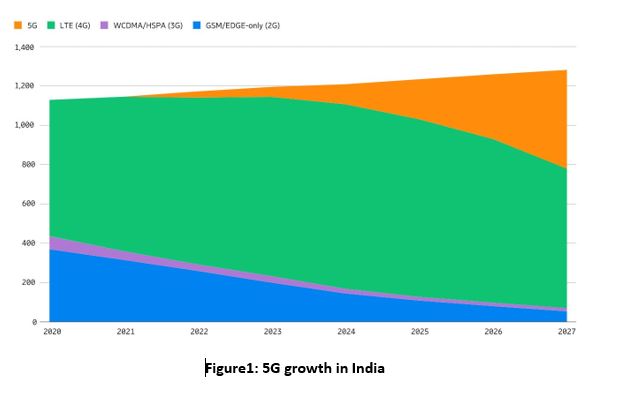
In a June 2022 report[2] commissioned by Ericsson, Omdia found that 52% of Indian enterprises it surveyed expressed a wish to start using 5G services within the next 12 months. Figure 1 from the same report demonstrates the significant growth of 5G within India from 2023 onwards. With the lack of installed infrastructure, using wireless backhaul links to roll out 5G networks is an obvious way to move forward, and is likely the only way to start addressing this huge demand. In recognition of this, and following petitions[3] from the ITU APT Foundation of India to the country’s Telecom Minister, there are now plans[4] by the Indian Department of Telecommunications to open up the spectrum at E-band (71 – 76 GHz and 81 – 86GHz) for backhaul, to support 5G network rollouts. At the same time they are delicensing V-band for WiFi services. These bands may be allocated via an auction process, or possibly by an alternative method of allocation, but a spectrum charge is expected to be applied to the network operators.
UK-India collaboration
The potential of the Indian market has also attracted the attention of the UK Government. Back in October 2021, UK Research and Innovation (UKRI) announced[5] that it was funding two collaborations between the UK and India, aimed at boosting 5G networks and future generations of telecoms. One is a grant to the Compound Semiconductor Applications Catapult to explore opportunities for further collaboration. The second is the UK-India Future Networks Initiative (UKI-FNI), a £1.4 million project involving UK and Indian universities and led by the University of East Anglia. The main aim of the project is to build relationships between the two countries towards increasing capability and capacity in 5G, and in developing telecoms diversification technologies for 5G and beyond. It is also intended for India and the UK to jointly develop a roadmap and research strategy for 5G and 6G, funded by UKRI India and UKRI’s Engineering and Physical Sciences Research Council (EPSRC).
Diversification
A key path toward diversification is the OpenRAN movement, under which the key elements of the radio access network (RAN) can be separated or disaggregated into individual elements. These can be sourced from a wider range of suppliers, and offers an approach that is likely to be favoured in India as the country starts to build up its own domestic telecoms supply chain.
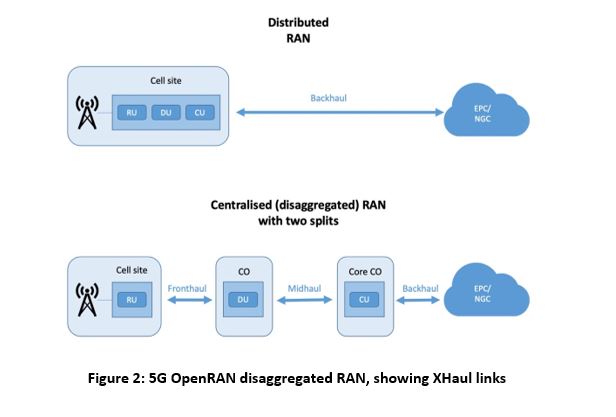
The key functional elements of the RAN – the Radio Unit (RU); the Distributed Unit (DU); and the Central Unit (CU) – need to be connected with each other via either optical fibre or an ultra-high-capacity wireless link, with the new connection between the RU and DU being called fronthaul, and that between DU and CU being named midhaul, as shown in Figure 2. Together with backhaul, these links are collectively known as Xhaul.
Suitability of E-band for Xhaul
Filtronic has been delivering E-band transceivers for backhaul for several years, and believes that wide-bandwidth mmWave radios represent the optimum solution to meet the increasing capacity demands for all types of Xhaul in 5G communications systems and beyond.[6] The proven ability of mmWave links to provide an equivalent capacity to fibre — up to 40 Gbps in multichannel configurations, over distances of up to 10km — combined with their ease and comparative low cost of deployment make them ideal for helping India meet its demanding telecoms market needs.
If you are looking to deploy E-band in India or elsewhere and are looking for the leading transceiver module, diplexer or SSPA, then contact the E-band specialists at Filtronic can offer the expertise and advice you need.
To continue its growth into the space and defence industries, RF-to-mmWave designer and manufacturer Filtronic has expanded its team of business development experts. The company has appointed Mark Whetton and Keith Scivier as business development directors to support its offering in existing sectors and increase capability for upcoming projects in 2023 and beyond.
Filtronic has a rich history of innovation and a 45-year track record of designing and manufacturing high-performance, customised solutions for complex sectors such as telecommunications infrastructure, aerospace and defence, space, test & measurement, and critical communications.
During his career, Whetton has occupied principal roles in the aerospace and defence sector and boasts credentials from companies such as Teledyne, e2v and BAE Systems, where he started his career. Scivier possesses a broad international military and civil aircraft background, with experience ranging from sales manager at BAE Systems to interim CEO of Ultra Electronics Chinese Joint Venture. In their new roles, Whetton and Scivier will be responsible for key programmes within the aerospace and defence, and space sectors, as the company looks to grow its market share within these dynamic growth sectors.
“Filtronic is going through a decisive expansion into new technologies and industries,” said Whetton. “Our experience within aerospace and defence primes, combined with our understanding of RF technologies and the various routes to market puts us in a great position to showcase Filtronic’s extensive capabilities to customers old and new.”
“We expect to drive growth and attract new quality customers,” added Scivier. “In the past year, Filtronic has opened a new design centre in Manchester to support the existing sites in Sedgefield and Leeds, strengthening our engineering technical capacity. With Filtronic’s continued investment in innovative UK manufacturing capabilities, we are looking forward to exploring and building new relationships with defence and space primes.”
Walter Magiera, Chief Commercial Officer of Filtronic added, “Over the past year we’ve invested in the workforce, which has been pivotal in maintaining our leadership in RF and microwave technology that is designed, made, and delivered in the UK. Mark and Keith’s vast expertise will reinforce Filtronic’s position, driving growth and creating strong relationships with new and existing key strategic clients.”
To find out more about Filtronic’s RF-to-mmWave solutions, visit the company’s website, or contact the team on +44 1740 618 800.
Designer and manufacturer of products and sub-systems for the aerospace, defence, telecoms infrastructure, space, and critical communications markets, Filtronic, has announced a new contract win with a leading global provider of low earth orbit (LEO) satellite communications equipment.
In recent years there has been considerable work undertaken to develop airborne communications networks that overcome the limitations of terrestrial networks. Challenges exist in designing these systems, one of which is the development of communications transport links that deliver sufficient bandwidth and range to provide comprehensive connectivity.
The contract, valued in excess of £2 million, requires the customisation and delivery of the company’s solid state power amplifier (SSPA), Cerus. Originally developed for early-stage High Altitude Pseudo-Satellites (HAPS) applications, the Cerus power module is based on Filtronic’s proprietary MMIC chip design and is provided in a small form factor module as a scalable SSPA. The Cerus module is available in 4, 8, 16 and 32-way configurations, offering power ranging from 4W to >10W at E-band frequencies.
The modules, and the related control boards will be installed in selected ground stations for commercial trials of the E-band earth station antenna links to and from the LEO satellite. This is the first time that high bandwidth E-band frequencies have been used in an operational LEO application.
“We are delighted to engage with a highly respected new customer at the leading edge of LEO space communications,” commented Richard Gibbs, CEO at Filtronic. “As the number of subscribers to LEO telecommunication services grow, maintaining network speed will become an increasingly important consideration for the service operator.
“E-band represents a viable licenced frequency band for the critical communication links to and from the orbiting satellite. Whilst terrestrial telecom companies have successfully used Filtronic E-band technology in their backhaul links for many years, this new contract award vindicates our decision to adapt Filtronic’s proprietary mmWave products for the emerging commercial LEO satellite market”.
Filtronic has been a major mmWave technology provider to the non-terrestrial and near-space HAPS and LEO industries for several years. To find out more about Filtronic’s RF-to-mmWave solutions, visit the company’s website, or contact the team on +44 1740 618 800.
by Walter Magiera, Chief Commercial Officer, Filtronic
Reliable access to high-speed, high-volume data communications has the potential to transform many industries and facilitate powerful new applications. These opportunities rely on the continued development of technologies to transmit, receive, and condition radio waves at higher frequencies, alongside the licensing of higher frequency bandwidths to accommodate huge increases in data traffic.
As technology evolves and new frequencies are approved for use, we examine some of the trends and opportunities for industries and applications in the years ahead.
– Space: commoditising satellite production
To support the rise of mega constellations of low earth orbit (LEO) satellites, RF device manufacturers are developing “off-the-shelf” space-capable high-power products aiming to improve the commercial viability of small satellite manufacture and deployment. The exponential growth in data traffic also means that space communications will need to move further up the frequency band, to E-band (71-76GHz / 81-86GHz) where there is an abundance of bandwidth and technology to support its’ use.
– Telecoms: make space for data
To manage forecasted data traffic, millimetre wave (mmWave) bands at the higher end of the frequency spectrum will need to be licensed for use by telecoms. The semiconductor processes and RF technologies required for W-band (92-115GHz) are well advanced – and will be ready by the time licences are granted. Work is underway to solve the fundamental challenges associated with D-band (138-174GHz), which offers much higher data rates, but requires significant changes to device architecture and advanced device packaging techniques.
– Defence: securing critical communications
In defence applications, unreliable or interrupted signals caused by congested frequency bands could cost lives. Moving up to higher frequency bands not only offers higher data rates, but also provides more directional signals that are harder to intercept. Alongside this, there is a push towards more digital signal processing in the radar signal chain. New technologies in the pipeline include ultrawide band (UWB) tuneable filters, operating across a broad spectrum of frequencies, which will be used to capture highly accurate spatial and directional data.
– Trackside-to-train: data on the move
The quest to provide reliable Wi-Fi on trains continues, and the UK has set targets for on-train data speeds. Creating high-data wireless environments on vehicles travelling at high speed poses significant technology challenges. Filtronic has developed a number of demonstration transceivers, which are now being trialled worldwide. These are successfully delivering E-band links to trains and could be commercially available in the next few years.
– High-frequency trading: gaining the competitive edge
High-performance private wireless networks are starting to be used to improve the competitiveness of high-frequency trading. Wireless point-to-point radio links can transmit signals milliseconds faster than fibre-optic cables. In such high-frequency trading where decisions are made by machine learning, the ability to make decisions a fraction of a second faster than the competition delivers a real competitive advantage.
– Quantum computing: solving complex challenges
The microwave circuits in quantum computers operate at superconducting temperatures, and are particularly sensitive to electromagnetic interference. Filtronic has developed advanced microwave filters to overcome this critical problem. RF technologies offer further potential to solve some of the unique challenges associated with quantum computing.
– Remote surgery: enabling precision operations
It’s now possible for surgical procedures to be carried out by specialist surgeons remotely – potentially enabling top surgeons to operate on patients in areas where local expertise is not available. Carrying out such precise procedures remotely requires ultra-reliable data connections with extremely low latency (lag) – which could be made possible in the near future by the transition to higher-frequency mmWave bands.
– Autonomous vehicles: unlocking future mobility
Driverless car technology is another advancement requiring extremely reliable, uninterrupted signals with low latency. Delivering this capability across road systems requires a dense network of transmit and receive functions, ideally at mmWave frequencies. Such reliable data connectivity could also be used for intelligent traffic light controls and other smart traffic-management solutions.
The future for RF technology
In all industries and applications, there is a hunger for more and faster data – which means moving signals higher up the frequency spectrum into the uncongested mmWave bands. As you move up the frequency spectrum, transmit and receive components become smaller and devices become more complex and integrated. Thermal management becomes an issue, and there is a need to increase power. All of this presents considerable challenges for advanced RF device designers and manufacturers.
At Filtronic, we enable the future of RF, microwave and mmWave communication, striving to optimise the size, weight and power of transceivers, power amplifiers, filters, combiners and other devices. We are leading the way in anticipating trends and developing the products required to unlock the future possibilities of high-frequency RF applications.
If you have a novel application or process that relies on high-speed, low-latency data communications, the RF specialists at Filtronic can offer the expertise and advice you need.
RF and mmWave specialist, Filtronic has further enhanced its hybrid and semiconductor packaging capabilities by investing in a fully automated wedge bonder suitable for power semiconductors, automotive power modules, and industrial power hybrids. The state-of-the-art auto-wedge bonder improves capacity and adds volume process capabilities that will enable the company to explore new markets. This addition to Filtronic’s production line will allow the company to offer greater than 1um die bonding accuracy , improving production yields and delivering highly repeatable packaging solutions.
Bonding custom compound semiconductor die for high reliability and system critical applications requires precision and high levels of accuracy. Historically Filtronic has used automated die attach and ball bonding but relied on highly trained operators to perform specialist wedge bonding operations. This approach has delivered high quality products but constrained factory throughput and limited the applications served. The automated wedge bonder investment fully automates the front-end assembly at the Filtronic hybrid manufacturing facility in Sedgefield County Durham and delivers significantly faster bonding speed using a variety of wire diameter from 0.5 mil – 3 mi It will be highly complementary to the specialist manual processes required for legacy applications.
“The automated wedge bonder further improves Filtronic’s agility, allowing us to introduce new products quicker than ever before, without compromising on quality,” explained Marc Adamson, Continuous Improvement Manager at Filtronic. “Our team of experts have trained to become specialists in the artisan skill of manual wire bonding, in some cases over several years. The introduction of the automated wedge bonder frees them up to work on alternative use cases, improving Filtronic’s agility across the entire business.
“Filtronic is committed to investing in resources which allow us to consistently deliver volume production with pinpoint accuracy at high tolerances,” continued Adamson. “The introduction of this new piece of equipment is the next step in our long-term plan to continuously improve our service offering for customers.”
If you have an application that requires a high level of accuracy, high volume of product and a quick turnaround, get in touch with Filtronic to see how, with its automated wedge bonder, the team could help.
by Richard Gibbs, Chief Executive Officer, Filtronic
They say that trust is hard-earned, and easily lost and this maxim lies at the heart of any successful business relationship.
Hard-earned trust accumulated by Filtronic over many years of innovative RF design enables us to have those open, honest two-way conversations with customers that only genuine partners can have. When you’re developing high-performance RF solutions at the cutting-edge of technology, such partnership working is critical. Real innovation in technology can only be achieved if there is 100% trust between both parties.
So how do you earn trust in such performance-critical markets? And, once earned, how do you retain it?
History of success
One key factor in establishing your reliability and trustworthiness as a partner is having a proven track record. If you have heritage as a business, it’s one of the most powerful ways to demonstrate your capabilities. Our own track record of successful project and technology delivery over 40 years has earned us a reputation for high standards in design, manufacturing and programme management.
Demonstrable expertise
Next, you need to have expertise that adds value to your customer relationships. Trust is built on performance. Our own customer research has shown that our engineers really differentiate themselves by their levels of expertise. That is the essence of trust – customers trust you as a supplier to bring the specialist expertise they don’t have in-house to solve their specific business challenges.
Independent accreditations
Independent accreditation is an important way to build trust with customers. It’s particularly important when you’re dealing with industries where security and confidentiality are non-negotiable. For example, at Filtronic we have the highest-level security accreditation required to work on defence and aerospace technologies. To achieve this accreditation, our processes, procedures, data management and documentation are rigorously audited to verify their compliance with international standards.
Protecting ideas
Trust is the bedrock of any partnership that requires ideas or intellectual property (IP) to be shared. Developing new RF technologies means bringing together our background IP with the background IP of our customers, so we can create something new. Customers need reassurances that knowledge will be shared in complete confidentiality. That’s especially relevant when we are dealing with different customers in the same industry. We follow robust practices to ensure that any component we develop or customise for a specific customer remains unique to them.
Innovation know-how
When you’re developing ground-breaking new technologies, customers need partners who will be honest and frank. It’s easy for customers to be seduced by the idea of a new innovation that appears to answer all their problems. But with our expertise and long experience in product development, we bring a dose of realism to the innovation process.
Having been through the iterative steps required to create new products, we know what’s feasible, how long it takes, and how to navigate hurdles along the way towards full scale manufacturing – so we can set realistic expectations and advise customers accordingly.
Big-picture thinking
Customers trust us to deliver technology that is fit for its specific purpose, reliable, and reproducible consistently in a manufacturing environment. We can do this because we have design, manufacturing and testing specialists all under one roof. It means our product designs have high-volume, high-yield manufacturing in mind from the outset, ensuring they are built for real-world applications. Our breadth of expertise enables us to guide customers through the transition from an R&D prototype to a precision product that can be manufactured at scale.
Creativity and adaptability
Trust is also earned in difficult or fast-changing circumstances. In recent years, we’ve seen trust grow in our ability to deliver on our promises at a time of supply chain disruption and global upheaval. Throughout this period, we have found ways to hit deadlines and meet deliverables by being adaptable and thinking differently to solve problems.
Early intervention
One thing we have learned from successfully delivering high-performance technologies over four decades is that the sooner customers bring our expertise into any programme, the better the outcome. Time to market for new technology introduction is critical and making the difficult design decision early in the process can help to ensure that delivery milestones are achieved. Even if we prove not to be the right provider to deliver the project, we can offer essential advice and insights at the inception to save time, resources and effort further down the line.
If you have a communication technology project in mind, don’t waste time trying to solve problems for which you have limited specialist expertise in-house. Filtronic can be trusted to offer the impartial expertise you need to set your project on the right track.
Filtronic have today announced that it has recently employed several additional engineers to extend the capabilities of both its design team and its process engineering team. At the same time Filtronic has announced the opening of a new design centre in Manchester, UK, focused on developing mmWave technology for satellite communications applications.
Following on from the appointment in October last year of Tudor Williams as Director of Technology, Filtronic has further strengthened its technical team with the addition of new principal RF and filter design engineers. The engineering team has been further expanded with the appointment of additional personnel, including MMIC, PCB and product engineers and two graduate engineers. Three process engineers have also been recruited, one of whom is a system-in-package (SiP) specialist.
“We are very pleased to welcome all these talented engineers to the Filtronic team,” said Richard Gibbs, CEO of Filtronic. “Over the past quarter Filtronic has received three significant new contracts, totalling over £1.2 million, and expanding our design engineering workforce will be key to maintaining and growing our leadership in RF and microwave technology.”
“Establishing the new centre for satellite communication design has enabled us to expand our physical footprint across three UK locations – Sedgefield, Leeds, and now Manchester – and has assisted us in being able to attract some of the best engineering talent in the industry,” said Tudor Williams, Director of Technology at Filtronic. “The Manchester design centre will further help us to pursue our strategy of targeting satellite communications as a key vertical market for Filtronic’s mmWave systems expertise.”
by Jerry Sanham, Business Development Director, Filtronic
Recent world events and an increase in geopolitical uncertainty has resulted in a renewed focus on building, supporting and strengthening of sovereign supply chains. UK businesses want to build robust, and resilient networks of suppliers, particularly in high-tech sectors. While government and national security agencies are keen to ensure that capability, technology and resources critical for national security remain available within the UK. Coupled with this there is a desire – fuelled by government incentives – to tap into the expertise, innovation and agility of SMEs to build UK competitiveness.
Security begins at home
There are sound economic, commercial and political reasons for investing in our UK supply chains, particularly in the current global climate. Alliances are shifting and the status quo is being upended due to global supply shortages. All catalysts which can quickly disrupt economies and previously well established and stable business models. Sourcing goods, services and expertise from within the UK minimises the risk of disruption and builds a self-sustaining business ecosystem – better able to withstand external shocks and geopolitical upheaval.
By ensuring we have the capability within the UK SME base to deliver advanced, hi-tech components and products, we can better support future-facing UK industries. Building this capability helps to protect local industries and jobs, while enabling businesses to design, develop and deliver truly innovative solutions entirely within the UK.
Thriving SME ecosystem
The good news is that the skills, expertise and capability already exist within the UK start-up and SME community. Many SMEs have impressive track records in their specialist fields and are developing world-leading capabilities in emerging technologies.
Filtronic is among those pioneering companies. We have been designing, manufacturing and testing advanced radio frequency (RF) technologies for more than 40 years. With the proliferation of communication channels and devices, there is huge demand for high-performance RF components to develop UK mobile telecommunications infrastructure, aerospace and defence systems and space capabilities. Within all of these industries, there is a strong motivation to invest in UK supply chains.
Smaller suppliers – bigger opportunities
Like other leading SMEs, Filtronic offers significant benefits to our supply chain partners. Firstly, we have a broad reach across several markets, which gives us the volume of orders and throughput to support innovative projects. For example, we produce thousands of modules per month for the telecoms sector, enabling us to invest in advanced precision manufacturing equipment. This allows us to develop high-performance components for lower-volume, higher-value defence, aerospace and space projects. We also apply lessons learned in one market to support innovation in others.
As an SME, we are willing to take on more challenging projects. We have a culture of pushing the performance boundaries, being flexible and adapting to specific customer needs. We can customise our components and services for individual projects.
Powered by ingenuity
Innovation is led by our multidisciplinary engineer team that includes RF, mechanical, PCB, test engineers and process engineers – giving us the breadth of capability required to take on ambitious turn-key projects that require real ingenuity.
Another significant benefit offered by Filtronic, and SMEs like us, is the vertical integration of our business. We can manage projects from design through manufacturing and testing seamlessly within our organisation. The size of our business means that communication and collaboration between different specialists is constant, and everyone understands their role in delivering complex projects. Such close collaboration ensures projects run as smoothly as possible and enables us to adapt and respond at speed.
UK-based world beaters
Many SMEs offer a unique combination of skills and capabilities. That is true of Filtronic, where we combine a rich track record in RF innovation with market-leading engineering expertise. We have also established a position at the vanguard of mmWave technology for next-generation communications. It all adds up to unique offering in the UK.
Like other businesses in the UK SME ecosystem, we are world leaders in what we do. Our technologies are vitally important to some of the UK’s biggest development projects. SME’s like ours deliver the essential building blocks that make the modern world go round – all designed, made and delivered in the UK.
Filtronic have launched the Morpheus X2, the latest generation of its market-leading E-band transceiver for carrier-grade applications in 5G backhaul, midhaul and fronthaul – collectively known as XHaul.
Morpheus X2 is the latest design based on Filtronic’s proven E-band (71 – 76GHz and 81 – 86 GHz) transceiver platform, of which over 75,000 units have already been shipped and deployed in radio links worldwide. Integrating all the RF transmit and receive functions required for an E-band radio link, the transceiver module offers a linear transmit power output of +23dBm; 3dB higher than the standard Morpheus II product – while occupying the same compact footprint of 90 x 80mm. Receiver noise figure is typically 7-8dB , and an enhanced option with 4.5-5.5dB noise figure is also available for specialised applications.
This higher power level enables longer link lengths when the modules are used in all types of mmWave XHaul applications. The compact form factor of the modules and their reconfigurable architecture also provide an ideal platform from which to develop ultra high capacity payloads and ground systems for LEO satellite constellations and High Altitude Platform Systems (HAPS).
“Morpheus X2 transceiver modules are manufactured in Filtronic’s precision microelectronics assembly facility in Sedgefield in the UK,” said Dan Rhodes, Director of Business Development ‒ mmWave Technology at Filtronic. “Our extensive in-house design experience, combined with our precise control over the manufacturing process, has enabled us to optimally match the transceiver interfaces with the internally integrated diplexer. This has allowed us to optimise RF when compared to packaged device architectures, and to achieve exceptionally high manufacturing yields against this leading, enhanced specification.”
Dell’Oro Group has forecast that E-band mmWave radio links will experience the fastest growth of all the frequency bands over the five-year period to 2026, with the combined E-band and V-Band market predicted to grow at a compound annual growth rate (CAGR) of 25%. This growth is being driven by the global demand for XHaul for 5G networks, for which radio links in the mmWave bands can provide both high capacity and high data rate.
By Mark Whetton, Business Development Director, Filtronic
Communications companies looking to launch large constellations of broadband satellites into low Earth orbit (LEO) are in a race to find reliable, qualified suppliers of radio frequency (RF) components to transmit and receive signals in space. But what should they be looking for in an RF component supplier?
Only a small number of RF manufacturers have a track record of supplying precision components for traditional geostationary (GEO) satellites, which remain in fixed orbit for up to 15 years. These companies have ‘space heritage’. Such businesses may seem the obvious choice when sourcing RF components for LEO satellites. But the specification of components for LEO satellites – which are launched in batches of tens or hundreds and have a lifespan of just five to ten years – is completely different to the specification for GEO satellites.
A history of producing high-specification RF components for GEO satellites may not be the best qualification for producing precision components at scale for cost-sensitive LEO satellite programmes. Perhaps satellite companies should look for a RF design and manufacturing company with space ‘capability’ as much as space ‘heritage’. But what do we mean by ‘space capability’?
To have the capability to produce RF components for LEO satellites, suppliers need a combination of knowledgeable and experienced people, proven and compliant processes and products, and precision manufacturing facilities.
Knowledgeable and experienced people
Technical specialists, RF, process engineers and project managers with hands-on experience of developing components and project-managing major satellite launch programmes are rare. But they are essential resources for any supplier bidding to design, build and deliver RF components for LEO applications.
Within Filtronic, we have a senior team of RF engineers with recent experience in developing and delivering pioneering LEO satellite. Such a combination of skills and expertise is unrivalled in the UK.
Proven processes and products
Filtronic has a long track record of developing transceivers, power amplifiers, filters and other components to meet the extremely high standards demanded by the mobile telecoms, aerospace and defence industries. We have developed stringent production, testing and screening processes to deliver high volumes of high-performance components for these critical applications. These proven processes and components are ideally suited for further adaptation to meet the demands of low earth orbit space deployment.
Precision manufacturing facilities
Delivering high-performance RF components at scale requires precision manufacturing to deliver consistent, repeatable standards in every product. Filtronic has recently invested significantly in its advanced manufacturing centre, introducing the latest automated die-attach and wire-bonding equipment. This enables us to work to much finer tolerances for placement accuracy and bond-wire shaping, which are critical to component performance. It also means we can reliably produce consistent products over large production runs.
Using the latest automated equipment helps us to reduce cost per component, without compromising quality. What’s more, by manufacturing components accurately first time, overall production times and costs are reduced due to minimal reworking and retesting. This enables us to meet tight programme schedules, minimising the risk of overruns that could delay satellite launch programmes. Any delays to planned satellite launches are extremely costly – meaning that on-time component delivery is crucial for these projects.
Heritage v’s capability
Companies with space heritage are accustomed to building small batches of highly specified components for long-term space deployment. Such individually built components are likely to be over-engineered for the demands of LEO satellites. Adapting these one-off components for LEO applications is far more complex than upscaling components already designed for volume production in demanding terrestrial applications. For companies with traditional space heritage, producing LEO satellite components at scale requires a huge cultural shift and a change in approach to budgeting, production and testing.
Companies like Filtronic, which have space capability, are much more accustomed to adapting existing components for new applications, adding new testing processes and innovating to meet fast-changing industry needs.
‘Heritage’ is a fixed company attribute. Whereas ‘capability’ reflects present-day resources and skills. To achieve the ambitious satellite launch objectives of today’s broadband communications companies, it’s the “here and now” that matters most.